Showing posts with label philosophy. Show all posts

12.9.11

existence shall cry, sis.


the painful thing about the residency i'm doing at collingwood housing estate is that it throws into question my purpose as an artist, in a way that none of the other recent residencies have.

i reckon i've had at least three grades of existential crisis in the last two weeks, the deepest last weekend, rescued by a fellow artist who reminded me that i actually don't get a choice over the future and what it thinks of me and my art. all i can do is be as attendant to the workliness of the work as possible (paraphrasing heidegger in his origin of a work of art).

going to too many openings, or other people's shows is too much for me when i'm in this state - i get caught up in my own sense of ridiculousness, so i have to pare it back.


having said that, i was able to check out two visual art shows and two sound art shows on the weekend and enjoyed myself immensely.

stephen palmer has a wonderful sense of putting shows together and the group show at light projects at the moment is a testament to that. the show focuses primarily on 'simulacra' and artists who replicate daily objects with such alacrity that we assume it is that item, lest we look closely, plus a light-hearted 'huzzah!' work by clare rae. in fact, her work was so unlike the others, that what it did state was 'this IS real'. which i liked.

the other exhibition is at dear patti smith - a gallery after my own heart. their brand hock show, in loving memory of amnesia is amazing - sculptural and narrative and slightly unnerving choices of symbols. i would even say feminist. it's well-crafted, well-lit and just exudes 'we are here'.


after both those shows, i attended two separate sound art gigs: one curated by nic tammens at the NGV studio, as part of his interesting collaborative residency there. we stood amongst oh-so-placed objects - attempted simulacra but to my mind were a bit, well, contrived.

clearly i was sinking in my own cynicism and i was too up-to-my-eyeballs-in-my-own-garbage to really enjoy most of the music, although it was nice to see some peeps and nic's band at the end was a great intense cello/violin/guitar distortion build and expressed my own mounting tension.

on saturday, after i had mostly dealt with my own internal combustion, i was able to really enjoy the embedded gig, presented by ben byrne and avantwhatever. all similarly toned bands (deep frenetic bass/low freq chaos
and a counterpoint of super-high pitch/frequency overlay), i enjoyed the different processes and instruments on display: upright bass, sub-bass actuators+40gal drums, jim denley's water-filled sax, trombone, accordion and alice hui-sheng cheng's vocal intensity.

the whole crew there were great and i felt really welcome at art beat - exactly the kind of art space that i believe melbourne needs a whole lot more of.

images: 
brand hock #2 (sorry, i chucked away the room sheet and can't remember the title)
new music series 001

17.8.11

interaction, part 1: goodbye.

Excellent goodbyes


i may be writing a bit about interaction in the next few weeks. primarily because the project i'm working on sits pretty firmly in the 'interactive' camp of arts practice. but also because i've been reading a bit about the philosophical aspects of interaction have been thinking about the dynamics of human interaction - listening, conversation and relationships.

counterintuitively, one of the first things i'm interested in unpacking a bit about is the interaction of 'goodbye'. i recently wanted to say a formal 'goodbye' to a stack of peeps in perth after spending much time in their tribe. sadly, and for a stack of reasons, not many people were able to make it, and i left wondering about the ritual of saying goodbye.

even though 'goodbye' is the end of an interaction between characters, it is also the beginning of a new interaction. it has its own set of variables and etiquette, rarely discussed in white, australian culture. the country of the laid back 'g'day' are also not so formal with their goodbyes. 'see ya'.

perhaps because i move around a lot, or because i've spent time in cultures for which the goodbye is given (linguistically and culturally) more weight, i'm finding that casual-ness a bit unsatisfying.

in schlock pseudo-psycho terms, there is no closure.

it's a metaphysical sentence that has no full stop. and when there's no punctuation, there ceases to be meaning. there also ceases to be intent. and therefore no beginning of the next interaction - the one of 'still friends, but separated by distance' or something.


in coding/system term, there's no } - no end to the instruction, which creates errors, which means you don't have an interaction. in not saying 'goodbye', one nulls and voids the interaction at all.


ok, so that's abstracting it and perhaps creating an analogy that simplifies things too much - human interactions are far more complex than a missing }, / or . but i do wonder if we lack consideration of the deeper sides to human interaction protocol (HIP) in the same way as we now do our other forms of interaction.

19.4.11

art and isolation


a while ago, a friend of mine sternly told me that i should watch that amazing TED video by Brene Brown on vulnerability. it took a few days, but on a cold, gloomy day in Berlin i sat in bed and watched.

i cried and i laughed. i laughed, like she said, in a knowing way 'oh god..'

and apart from hitting some personal nerves, i loved what she says about humanity's need to connect. actually i believe this need built into our cell.db - but even if it isn't, history has consistently presented to us our need for connection and the damage that is done in isolation.

Mauer Monument

having said that, when i was in berlin, it was the first time i got in touch with a level of isolation (and therefore vulnerability) that i hadn't experienced before and i thrived.

i was removed from my big group of friends, my sense of complacency about navigating public space/the shopping experience, my command of language and even the outside world for a couple of weeks (i spent a week only going downstairs to get coffee and then coming back up to the apartment).

but there was something about that 'outsiderness' that enabled me to really get to know myself, my work and my place in the world. sorry. i can't believe i just wrote that either.
what i'm trying to say is that i discovered the complexity of isolation. it turns out i needed a little something of 'removed' in order to have the space to be.

obviously, i'm a modern young lady/geek, so wasn't completely isolated. i was still checking into blogs i hang out on, twitter, facebook, e-newsletters and phone calls to people. and, to be honest, the fact that i was in germany and within a culture that doesn't reject art-making kind of helped.


cut to: perth.


WA_0005


isolation is a thing here.

the population is actually small (as opposed to the rhetoric of small population as excuse for poor public service. another rant), the feeling of being closer to jakarta than the canberra is palpable and unless you live within walking distance to work like i do (ha!), it takes bloody forever to get anywhere. it feels like time slows down here.

so, it's little wonder that there is a combination of intense frustration and intense production here. the artists that are here are super generous, fruitful and really focused on making work that is interesting, engaging with technology and pushing boundaries. i think there's a reason that there are more art schools in perth than in melbourne, that anyone interested in working with bio/body/electronic art comes to perth and that the state of WA was the first to implement a percent for arts scheme.

perhaps in the same way that iceland is a feminist country - there's not the overbearing bully neighbours to tell you what to do, so you just fuck it and do it anyway.

WA_0007

i could go on and talk about the link between isolation and space for shame, that enables people to act freely. and i could go on about space/time for contemplation too.

but the other aspect to being separated from the rest of your pack is that you feel vulnerable.
and lonely.
and there's no room for complacency.
sometimes being complacent is a wonderful thing, even for an artist.
not having to fight for your right all the time can be valuable.

how can technology and the internet and the rest of the world help meter your isolation, so that you have just the right amount of "come here and go away."

4.4.11

oh how did she know...


so, so true.

thanks to sarah bear for finding this one. thanks to natalya from flickr for posting it

12.3.11

sexy heidegger


"When a work is created, brought forth out of this or that work material... we also say that it is made [set forth] out of it. But just as the work requires a setting up in the sense of a consecrating-praising erection... so a setting forth is needed."

Origin of a Work of Art, from Martin Heidegger: Basic Writings, Harper Collins 2008

influenced by Courbet's Origin of the World perhaps?

6.1.11

she sees read


while my laptop was hanging out with virgil in purgatory, i managed to chew through a few books, unsurprisingly. [i also managed to make my own christmas cards, wrapping paper and cookies. but that's not what i'm going to post about, obviously.]

and i just thought i'd share about these books a bit, because, as it turns out, they're all linked in some way and all three have effected me in a profound way - existentially. the nice thing is that two of them were gifts too, which means i now have awesome mind-reading friends who know exactly what kind of garbage to put in my brain.


the trickster makes this world: how disruptive imagination creates culture  lewis hyde.


apparently there's quite a famous book by lewis hyde called the gift. i'd not heard of it, so this author and his second big title was all new to me. i was a little dubious about that subtitle, but i peeked at the first page and was hooked from the get-go. in fact, i cheated on the book i was reading at the time - ditched it in favour of the first chapter under the covers. ooh er..

basically, hyde uses stories in mythology about various trickster characters, to show that the wiley, crafty and chaotic traits of the trickster are a vital part of society. He then matched those traits in stories/principles with the traits of the artist in modern society, as a vital trickster character that keeps everyone on their toes.

some of the other areas that i found fascinating included place of chaos/dirt/upheaval (or images thereof) in orderly society; the need for shame/shamelessness in social cohesion; and the skill of a trickster to play with perception, whilst holding the order of perception dear.

Hermes, Coyote, Monkey (and tripitaka), Ifa/Eshu, Picasso, Duchamp and Cage (are all referenced as figures that simultaneous understand the lay of the status quo, respect it and yet seek to subvert or circumvent it, whilst offering it back to the quo on a gold platter, having completely reinventing the status. [And maybe because I was listening to the new Kanye album non-stop during this time, I kept imagining that Kanye West would end up in there in the future sometime.]


the actual writing flow of the book was slightly problematic, but the way he teased out his examples, and the kind of stories he chose as illustration was so good, that i could forgive the lapses in writing craft (just like you're doing now).


there is an admirable element of playfulness about the trickster which hyde kept reiterating (and about which i have a creeping doubt that i have lost recently). it was inspiring to get a bit cheeky, a bit naughty and throw caution to the wind a little. nothing reflects a security in the order of 'things' than acting as though they're not important.

the book was an excellent reminder about the role  of chaos, entropy, mishap, coincidence, serendipity and mistake in evolution, change, growth and innovation. trickster also served as an illustration of the position stories, myth, artifice, imagination and fiction have in society as a way to abide by principle and establish a code of conduct.

ISBN-13: 978-1847672254


the canon: the beautiful basics of science. natalie angier


whilst i was reading the trickster, i had an invigorating discussion about science and religion with a friend who had just finished the canon. we were the only ones in a club in stockholm, laying on a mattress and shouting over 105 rpm techno at 95dbs, debating the importance of scientific thinking and spirituality and everything in between. it was a brilliant moment in our friendship, and the momentum to read this fantastic book.

its premise is to concisely and adroitly recap the main tenets of science and scientific research, to upskill adults in the basics. especially after they have convinced themselves that they know nothing about science.

as a science writer, angier surveyed a stack of scientists and academics for their 'top 5 things to know about your field' type information. each chapter covers the principles of each 'flavour' of science, distilling the history of its knowledge and how it relates to life, the universe and everything.

scientific thinking, probabilites (maths), calibration (maths), physics, chemistry, evolutionary biology, molecular biology, geology and astronomy are all covered - from their history to current thinking. and of course, she covers where religion and astrology clash too. in fact, sometimes her subjectivity around the subjects of religion and even intelligent design, and her outright derision at astrology show her cards a little.

in the last two years of high school, despite being a A+ english student and studying 3 languages, i decided that i wanted to be an industrial chemist. so i moved to sydney and started a science degree. turns out it was much harder than i thought: i was convinced i was a failure (thinking that 72% on an assignment was akin to disaster) and the fact that my week would start at 8am  on a monday with a mathematics class on matrices in a stuffy room, was a recipe for flunk-out. i bid science a swift adios and turned to print and art instead.

i kept a secret crush on mathematics and chemistry through those years and so reading the canon was like falling in love again. all the old lessons came flooding back, with greater links to subsequent experience or knowledge. the picture of how much everything is related scientifically was quickly seen and i just churned through the book.

thanks to a catholic education, my knowledge of the details of evolution had been a bit loose, so this book was a mind-blowing and yet super easy-to-read lesson on how far we go back (like, to the beginning of cells) and same with the big bang theory. the idea that cells' innate mission has always been to respire, replicate, excrete, communicate and coalesce is mind-boggling to me and is influencing my next read.

i feel like i know more about science now and that i can't hide behind the ignorance of learning it in high school - it's part of a general knowledge and understanding about life. in the same way that i feel it's necessary to understand concepts in philosophy, economics, politics and art in order to be a well-rounded citizen (how neo-classical of me).

and i can see why my friend gave this book to me (and six of his other friends). i feel similarly - like everyone who has let their science knowledge lapse, should pick this up and feel like they know a little more again.

in fact, it was so profound that i ended up in a two-hour conversation with a paleonto-bio-mechanic about his PhD and i held my own! yay me!


ISBN-13: 978-0571239726


basic writings. martin heidegger


i stopped and started with this one. i got distracted by shiny pop non-fiction. but now that i've read both of the previous books, i feel like my take on heidegger is going to actually be better prepared. especially after reading about molecular biology and the big bang (which trace the history of the life, the universe and everything, back to the beginning - before there was even 'let there be light'). After reading about these things, i keep asking myself 'why did life begin? - what is the purpose of Being..

heidegger's big area of questioning/interrogation/query (words which he unpacks as a sign of being) is about Being, with his famous work Being and Time (Zeit und Sein). It is the very capital-B being and different from existence and the nature of being. So far, he's primarily interested in the meaning of Being, and not necessarily the purpose, or the drive behind it. But i'm only a little of the way through so far.

thanks to the simplicity of the english language, there are a lot of being/Being/beings in the text, which are translations from Dasein, Dass-Sein, Was-Sein and Da-Sein. All different relationships to Sein ( the action of being).

heidegger unpacks his questions in a very methodical way, and makes a lot of references to other sciences that tackle existential concepts (which is why i feel like reading The Canon has unexpectedly augmented my understanding of Being and Time). It has been quite interesting to see the history of his thinking around it and the critical 'evolution' of such ideas throughout philosophy and ontological research.

on a more egocentric level, are there levels or classifications or even species of Being? what does the Being of an artist translate to and is it fundamentally different to the Being an accountant? or does it follow biological framework - that the Being of a vertebrate is different to the Being of an invertebrate, but has mutual elements of Being, both being from the animal kingdom and eurakyrotic domain. Or is there just one type of Being?

ISBN-13: 978-0061627019


images: all images from amazon.co.uk

23.5.10

listening and silence in the built environment

LTC_01_080609

if you're in melbourne on thursday night, and feel like participating in some discussion about sound, listening, silence, contemplation, architecture, the built environment, philosophy and quietitude, you're in luck.

i'll be giving a lecture as part of the architecture + philosophy series,

covering ideas about listening/silence and the forms of acoustic spaces which facilitate them, i'll focus on the grotto, the cloister, the autobahn and the headphone as a bit of a progression of those spaces.

i may also quote some adorno, some john cage and even wikipedia. just to keep it real.

and i'll also be speaking about some of the work that i've done which relates to a lot of these ideas.

starting at 6:30 pm, it is held at RMIT and will be an interesting night with some thought-provoking discussion. which usually comes from the audience :D

deets:
Thursday May 27, 2010
18:30
RMIT Building 8, Level 11, Room 68 (8.11.68).
Entrances are on Swanston and Bowen Sts, between Franklin and La Trobe Sts.

No need to RSVP, just turn up.

6.11.09

on purpose, act III


i've been thinking about the relationship between purpose and beauty a lot lately. it seems i believe that the purpose of all good humans is to be beautiful and that if you're not, you're pointless.

yet, if you had've said that directly to me, i would have told you to get fucked.

i'm practicing the art of having purpose lately. not the kind of purpose that rationalises the bejesus out of everything, but the kind that counteracts the idea of beauty-as-value that rationalises the bejesus out of everything. and yes, i do see the irony of this situation, given that, as an artist, i'm supposed to be on beauty's side.

25.9.09

site-writing

i'm a whole week behind on posting about this, but it's always better late than never, right?*


last friday, as part of the architecture + philosophy series, design research institute and the urban interior research group from RMIT, jane rendell - writer, architectural designer, art critic and historian from the bartlett (ucl) in london- gave a presentation: to and fro: site writing.

she spoke about the role of writing in terms of art/architecture, the role of critique, the influence of ego and the id on critical architecture and the inevitable interstitial space between public and private.

i left the lecture almost bursting with ideas. in fact, i almost left myself a voicemail message as a reminder of all the cool stuff i had heard. i kind of wish i did because, 7 days later, all i can remember is the feeling and a faint connection to the notes i took.

she does have a new book coming out soon - site-writing, in which the process of critique and writing has been developed into a more formal process-based work, in which the various forms of language about site and experience are interspersed, a collage of sorts, even.

and as interesting as that is, a point of discussion which we had included the importance of purely functional writing and/or critique. where the traditional roles of object and outcome remain separated and the writer takes on the role of designer - responding to a brief: to articulate the nuance and visual code of an artist/architect/performer's work

there were a couple of key points, which i thought were particularly interesting.

1. immersive critique - whereby the writer responds to the work, not as a detached observer, or dissociated object, but from within the space. it reminded me about andrea fraser's 'little frank and his carp' - the video work she did where she responded to the guggenheim by literally following the directives of the audio guide - rubbing herself on the smooth walls, etc.

2. repression presents itself through repetition. i thought this was a particularly interesting concept. coming from a 'history never repeats' aspect, but i guess from an aesthetic position, it's something i'd be interested in researching some more.

3. the relationship of feminist theory and psychoanalysis to architecture. luce irigray is prime example, but i love being part of a discussion where the concept of design acknowledges gender politics and sexual identity. goodness abound.


i'm hoping that her presentation/paper will be uploaded to the arch+phil site soon, because i need a refresher course, but in the mean time, here is link to her presentation for one day sculpture in nz.

and some pics of my notes. you know, writing as image and back again [click to enlarge].


*except having your period. then it's always better never.

23.7.09

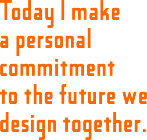
today i make a commitment to the future we design together.


initially this was going to be a post about the state of design festival, a project that i planned and one organised by those fabulous ladies over at architecture + philosophy. it was going to be about the future of acoustic spaces, one of choice and the generation which has a commitment to choice.

but instead it's going to be about backing out of a commitment in order to preserve ones integrity. about not designing for the sake of an opportunity, but having the restraint to remain authentic to a level of quality and/or clarity of message.


you're all sick of hearing about my research into sound in the public space, but when i was working towards project for this final semester, i checked out to see what the state of design and their fantastic cultural program were doing, remembering that their theme was 'sampling for the future' - what an awesome partnership: sampling, sound, choice, the future, architecture/design and public space.


i got in contact with the peeps at SoD and it was all very exciting - a last-minute inclusion, but one which could still happen in the 6-week turnaround. sometimes, when the timing is right, everything just flows and you can pull off a project in record time.


this was not one of those times.


as soon as we locked it in, everything just ground to a halt: suppliers were out of stock, samples couldn't be shipped and, more importantly, i just couldn't unlock any money from anywhere and i was fast running out of time to find some. [granted, it's not my field of expertise and i'm sure if it was i would know exactly where to find some, but hey - i is what i is].

i started to be anxious all the time - losing sleep about where i was going to find the money for this, how could i source that from overseas to save time, how could i work the timing around work and i needed to brief the volunteers. the list of things to do kept getting longer and longer. and i wasn't kicking any goals. as each day towards the deadline kept ticking over, the project was getting less and less finished. it was going to be a really crap install, the way this was going.

and, more importantly, i was miserable about it.

i had no faith in the work, i was barely talking about it - i sure as hell wasn't promoting it anywhere until i had a level of satisfaction about it and i was losing any kind of perspective, commitment and aesthetic judgment, fast. i was hemorrhaging.

so, whilst at the ballet with my mum, after barely noticing the first act, i decided that i needed to pull out of the project. i needed to risk disappointing a few, in order to salvage the best parts of the idea. to not present a half-baked design which would benefit, delight or inspire no one. i made a commitment to the future i designed. just not together. and just not right now.

i can't tell you how much lighter i felt. it was instant. and i suddenly had room in my head (and excitement in my heart) for the other projects i was working on. i suddenly had some clarity about works that really did have enough time. and enough money. and i knew that i had reached some kind of milestone - some weird internal rite of passage, where i had said 'no' to a great opportunity, for the sake of my work. it seemed almost old-fashioned (you young whippersnapper, you).

unsurprisingly, i had a whole swag of support for this lack of commitment. LI, NT, DR and GJ were all stellar. and of course my mum was delighted. not just because i paid attention to the second half of the ballet, but nothing worries a mother more than seeing a furrow tattooed into her child's brow.


so, today i make a commitment to the future we design together. by pulling out of projects, in the interest of my own integrity.
and in doing so, i commit to the value of that design and of that future.

26.11.08

having the courage of your conviction.

Donkey Kong

2008 has been a doozy of a year. i thought last year was crazy, but that was all fun and games and meeting people and seeing art, really.

this year has been a year in which i've had to learn some really hard lessons about following dreams.

in fact, following on from the last post about gaming, i feel like 2008 has been about clocking level after level of donkey kong. those barrels have just kept coming, but releasing the big guy from the cage has become more important and more important.

a couple of times i swore i was just going to roll over and be a lawyer or investment banker. well, then the financial vortex happened and i realised that maybe being an artist on the other side of the world might just be the coolest thing to do ever! ha!

This year isn't over yet, and there are still a few hurdles to jump: like trying to convince the biggest entity in the universe (not god, but close) that an idea of mine is worthwhile shifting slightly sideways for; and the next round of employment goodness (more on that later); but i did just want to say thank you to a few people who kept yelling from the sidelines (you know who you are)- i think i finally realised what conviction really means.

it's all about donkey kong and jumping barrells.

24.8.08

life is like a bicycle

to keep your balance you must keep on moving.
-Albert Einstein [in a letter to his son]


thanks swiss miss

5.8.08

how to work better

How to Work Better - Fischli/Weiss

A much needed reminder at the moment.


original work by Fischli/Weiss. image from rytc on flickr